Behavioral Interviews for Software Engineers
Pass the behavioral round on evidence, not charm. What interviewers measure and how they score it, how expectations change from junior to staff, building a story bank with STAR, showing impact with numbers, the question families every loop asks, the signals senior and staff candidates must show, and how to handle probes, company values and mock rounds.
Course Overview
The behavioral round decides more offers and more levels than most engineers expect, and it is the round they prepare for least. This course treats it as an engineering problem with a clear specification. Interviewers are collecting evidence about a small set of signals, ownership, ambiguity, collaboration, conflict, growth and impact, and they score that evidence against a rubric that depends on the level you are interviewing for. Once you know what they are writing down, preparing becomes a concrete project.
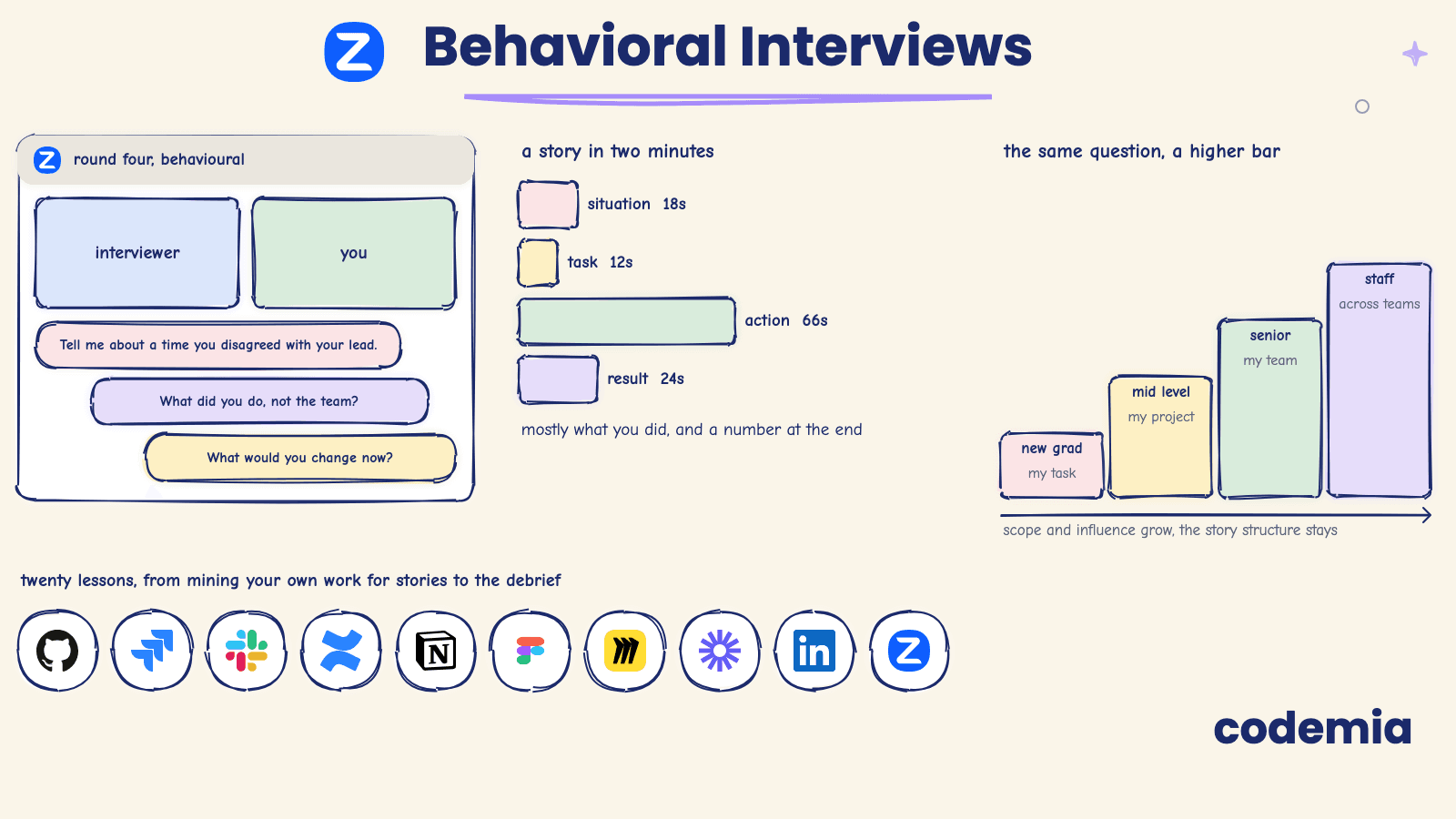
The first section explains what the round measures, how interviewers score answers and run the debrief, and how the bar moves from a new graduate to a staff engineer. The second builds your story bank. It covers the STAR structure and its variants, a method for mining your own projects, incidents and reviews for stories, how to quantify impact honestly, and how to tell a story in two minutes so the probes have room to work.
The third section works through the question families that appear in almost every loop: conflict and disagreement, failure and mistakes, feedback given and received, ambiguity and prioritisation, and ownership. Each lesson shows what a strong answer contains, the traps that cost candidates the signal, and worked examples of weak and strong versions of the same story.
The fourth section covers the signals that separate senior and staff candidates: leading without authority, technical decisions and trade offs, mentoring and growing others, and driving change across teams. The final section is about the room itself, follow up probes and deep dives, company values and how to tailor stories to them, your career narrative and why this company, and a practice plan with mock rounds.
By the end you will have a tagged bank of real stories covering every signal at your level, a structure for telling each in two minutes, and practised answers to the follow up questions that decide the score.
Course Content
5 Chapters • 20 Lessons
Not what you were looking for? Have Basis Lab write you a course on it. It is a separate product from the same team, and the first course is free.
Enroll Now
Get instant access to all current and upcoming courses by subscribing.