Concurrency and Async Programming: Threads, Locks, Event Loops, and Backpressure
Concurrency from the hardware up. Threads and the scheduler, races and memory models, locks, condition variables and atomics, thread pools and queues with backpressure, futures and actors, event loops and async await, goroutines and channels, cancellation, timeouts and testing concurrent code, with judged problems that simulate schedulers, locks and event loops.
Course Overview
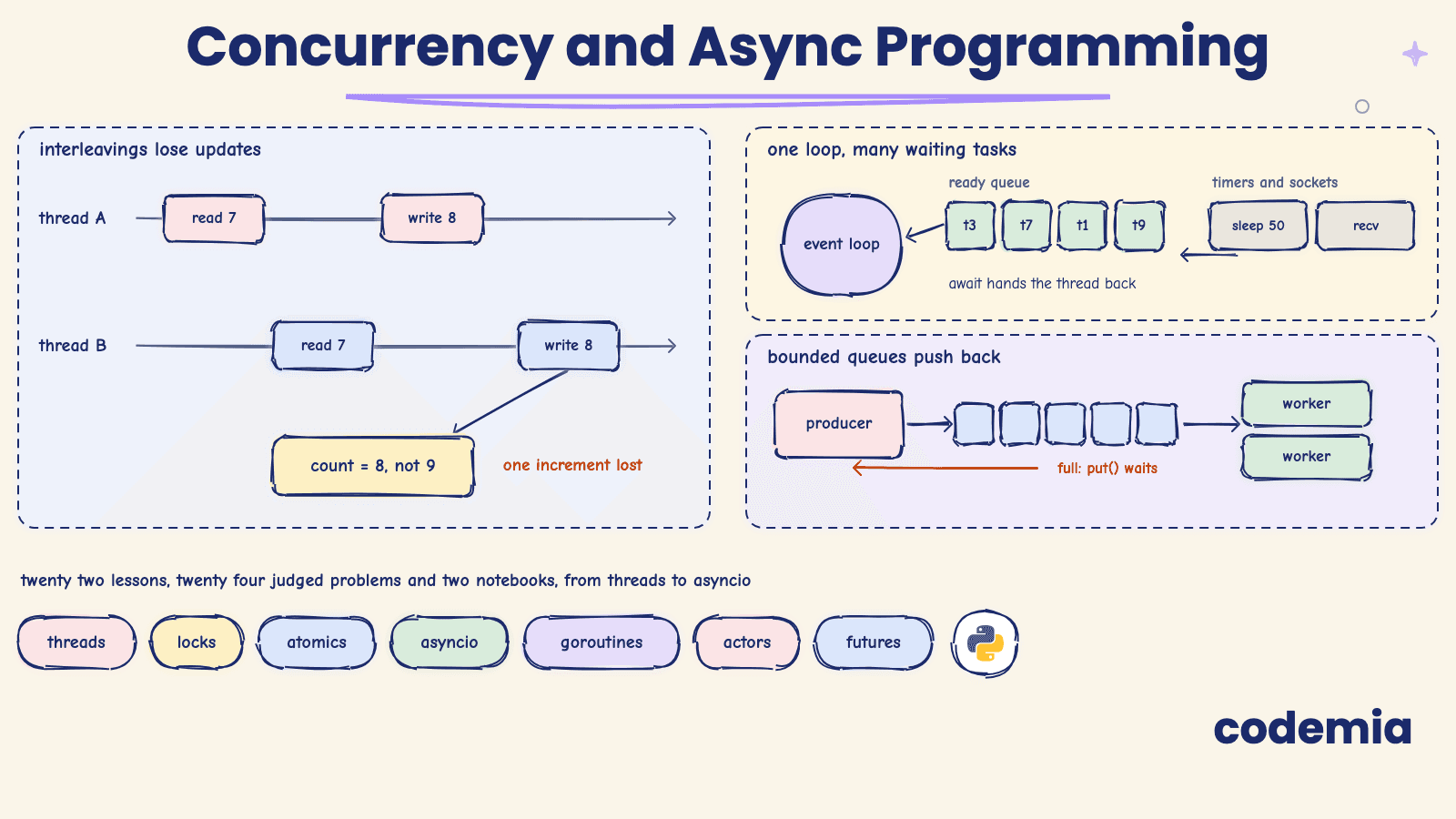
Concurrency bugs are the ones that pass every test and fail in production at three in the morning: a counter that loses increments under load, a deadlock that appears once a week, an async service whose latency explodes because one call blocked the event loop. This course builds an accurate model of what actually happens when several things run at once, so those bugs become predictable instead of mysterious.
The first section covers foundations: why interleavings make concurrency hard, how threads and the operating system scheduler work, the difference between race conditions and data races, and the memory models that decide when a write made by one thread becomes visible to another.
The second section is synchronization: mutexes and critical sections, condition variables and semaphores, deadlock, livelock and starvation, atomic operations and compare and swap, and the lock free data structures built from them.
The third section covers concurrency patterns: thread pools and executors, producer consumer queues with backpressure, futures, promises and fork join parallelism, and actors with message passing.
The fourth section is asynchronous I/O: blocking versus nonblocking I/O and readiness APIs such as epoll, event loops and the reactor pattern, how async and await compile into state machines, Python asyncio in practice, and goroutines, channels and green threads.
The last section covers concurrency in production: structured concurrency and cancellation, timeouts, rate limits and bulkheads, testing and debugging concurrent code, and choosing a concurrency model for a real system. Judged coding problems simulate schedulers, locks, queues and event loops, and notebooks build a tiny event loop next to asyncio and measure queues, backpressure and loop lag.
Course Content
5 Chapters • 22 Lessons
Not what you were looking for? Have Basis Lab write you a course on it. It is a separate product from the same team, and the first course is free.
Enroll Now
Get instant access to all current and upcoming courses by subscribing.