Distributed Systems: Consensus, Clocks, and Replication
The theory under every database, queue and coordination service you use. Partial failure and system models, physical, logical, vector and hybrid clocks, leader, multi leader and leaderless replication, quorums and CRDTs, linearizability and weaker consistency models, CAP and PACELC, Raft and Paxos, leases and fencing, distributed transactions, gossip and failure detection, and how distributed systems are tested.
Course Overview
A distributed system is a set of computers that cooperate over a network that can delay, drop and reorder messages, where any machine can stop at any moment and nobody can tell for sure whether a silent machine is slow or dead. Every database, queue, cache and coordination service you run in production is built on a small set of ideas for coping with that. This course teaches those ideas directly, the way senior and staff interviews probe them and the way production incidents demand them.
The first section sets up the problem: why partial failure changes everything, the system models that say what can go wrong, and how timeouts, retries and idempotency behave on a network you cannot trust. The second is about time and order. Physical clocks drift and jump, so systems order events with Lamport clocks, track causality with vector clocks and combine both in hybrid logical clocks and TrueTime.
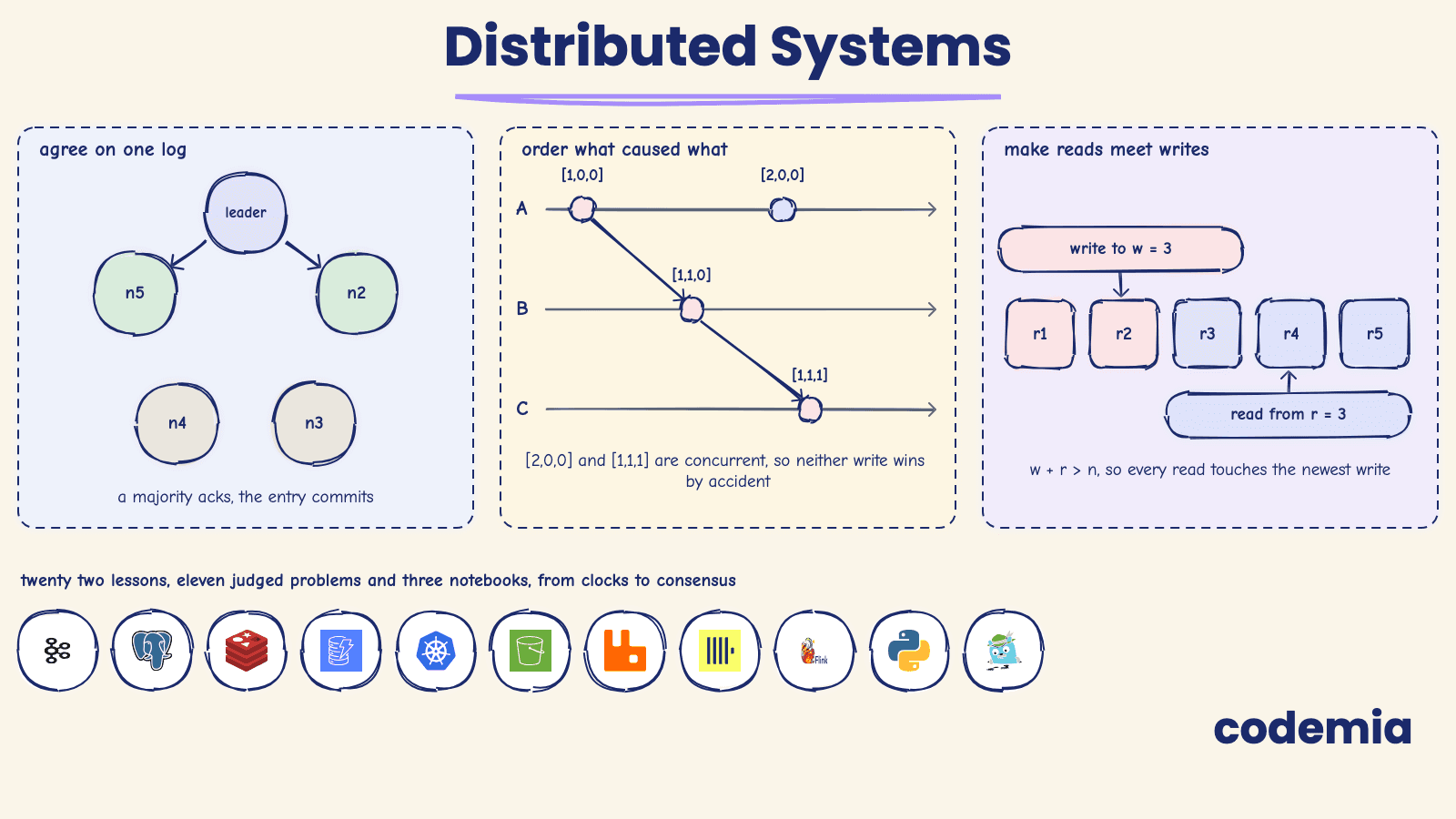
The third section covers replication: leader and follower, multi leader and leaderless designs, quorums with tunable consistency, and conflict resolution up to CRDTs that merge without coordination. The fourth makes consistency precise, from linearizability through causal and session guarantees to eventual consistency, and places CAP and PACELC where they actually help.
The fifth section is consensus: what the problem is and why FLP says it cannot always be solved, Raft leader election and log replication in detail, Paxos and Multi Paxos, and the coordination services, leases and fencing tokens built on top. The last covers distributed transactions with two phase commit and sagas, gossip membership and failure detection, and testing distributed systems with fault injection and model checking. Judged coding problems and notebooks let you implement clocks, quorums and Raft rules and watch them under failure.
Course Content
6 Chapters • 22 Lessons
Not what you were looking for? Have Basis Lab write you a course on it. It is a separate product from the same team, and the first course is free.
Enroll Now
Get instant access to all current and upcoming courses by subscribing.