Introduction to Agentic AI
Understand how AI agents work, from LLM foundations to production-ready agent architectures.
Course Overview
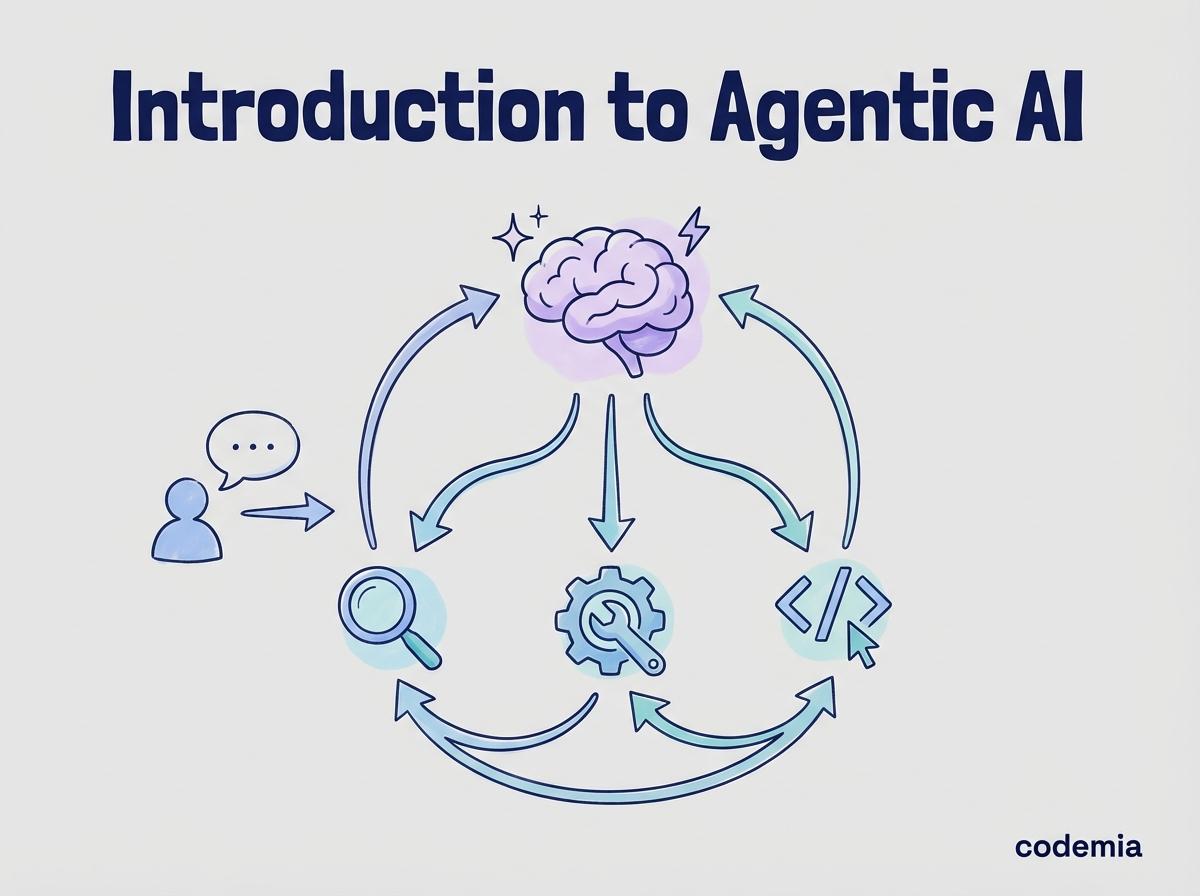
AI agents are the next evolution of software systems. Instead of writing explicit instructions for every scenario, you give an LLM the ability to reason about a task, use tools to interact with the world, and iterate until the task is complete. This is a fundamental shift: from deterministic programs to systems that decide what to do at runtime.
This course teaches developers the concepts, architectures, and trade-offs behind agentic AI systems. You will learn how LLMs work under the hood (just enough to make good design decisions), how the agent loop turns a chatbot into an autonomous problem-solver, how memory and retrieval give agents persistent knowledge, and how to design agent systems that are safe, observable, and cost-effective in production.
No frameworks. No framework lock-in. The course focuses on patterns and principles that apply regardless of which LLM provider or tooling you use, because production agent systems are almost always built with custom orchestration, not off-the-shelf frameworks.
By the end of this course, you will have the mental models to design, evaluate, and reason about agentic AI systems, whether you are building one, interviewing for a role that involves them, or making architectural decisions about when (and when not) to use agents.
Course Content
8 Chapters • 27 Lessons
Not what you were looking for? Have Basis Lab write you a course on it. It is a separate product from the same team, and the first course is free.
Enroll Now
Get instant access to all current and upcoming courses by subscribing.