LLM Inference and Serving: GPUs, Batching, and Cost
How large language models actually run in production. Prefill and decode, the KV cache, latency metrics, GPU memory and the roofline, tensor, pipeline and expert parallelism, continuous batching, paged attention, quantization, speculative decoding, FlashAttention and disaggregated serving, inference engines, routing, autoscaling, multi LoRA serving, cost per token, caching, and evaluations in production.
Course Overview
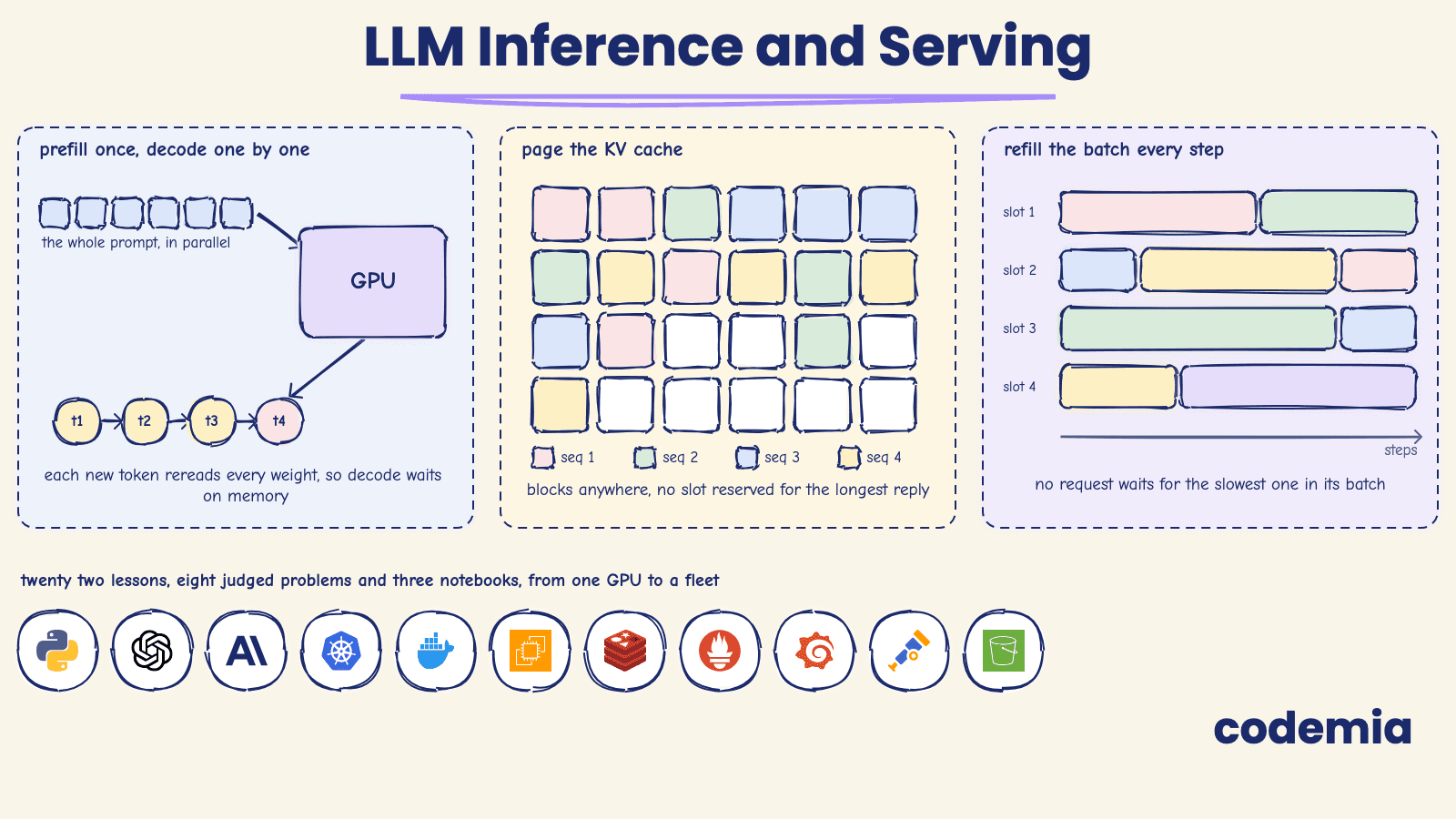
Calling a model API is easy. Running a model yourself, or understanding why an API is fast, slow, cheap or expensive, takes a different set of ideas. Inference is limited by memory bandwidth more than arithmetic, its cost is set by how many requests share each GPU step, and its latency has two separate parts that respond to different fixes. This course teaches the engineering of LLM inference and serving, the work that AI infrastructure, platform and applied engineers are now hired to do.
The first section explains what happens during inference: tokens, the forward pass, the split between prefill and decode, the KV cache that makes decoding feasible, and the latency metrics that describe it, time to first token and time per output token. The second is about hardware: how a GPU is organized, why decoding is memory bound, how to budget memory for weights and cache, and how tensor, pipeline and expert parallelism spread a model across devices.
The third section covers the techniques that make serving fast: continuous batching, paged attention and prefix caching, quantization of weights and cache, speculative decoding, FlashAttention and fused kernels, and chunked prefill with prefill and decode disaggregation. The fourth turns to serving systems: inference engines such as vLLM, SGLang, TensorRT LLM and TGI, gateways and cache aware routing, autoscaling with slow cold starts, routing across models, and serving many LoRA adapters on shared GPUs.
The last section covers cost and operations: turning GPU hours into cost per million tokens, prompt and semantic caching, evaluations that catch quality regressions when a model or quantization changes, and the observability and reliability practices that keep a serving fleet healthy. Judged coding problems and notebooks do the token, memory and batching arithmetic that every serving decision depends on.
Course Content
5 Chapters • 22 Lessons
Not what you were looking for? Have Basis Lab write you a course on it. It is a separate product from the same team, and the first course is free.
Enroll Now
Get instant access to all current and upcoming courses by subscribing.