Loading...
System requirements
Functional:
Given long url -> return shortened url
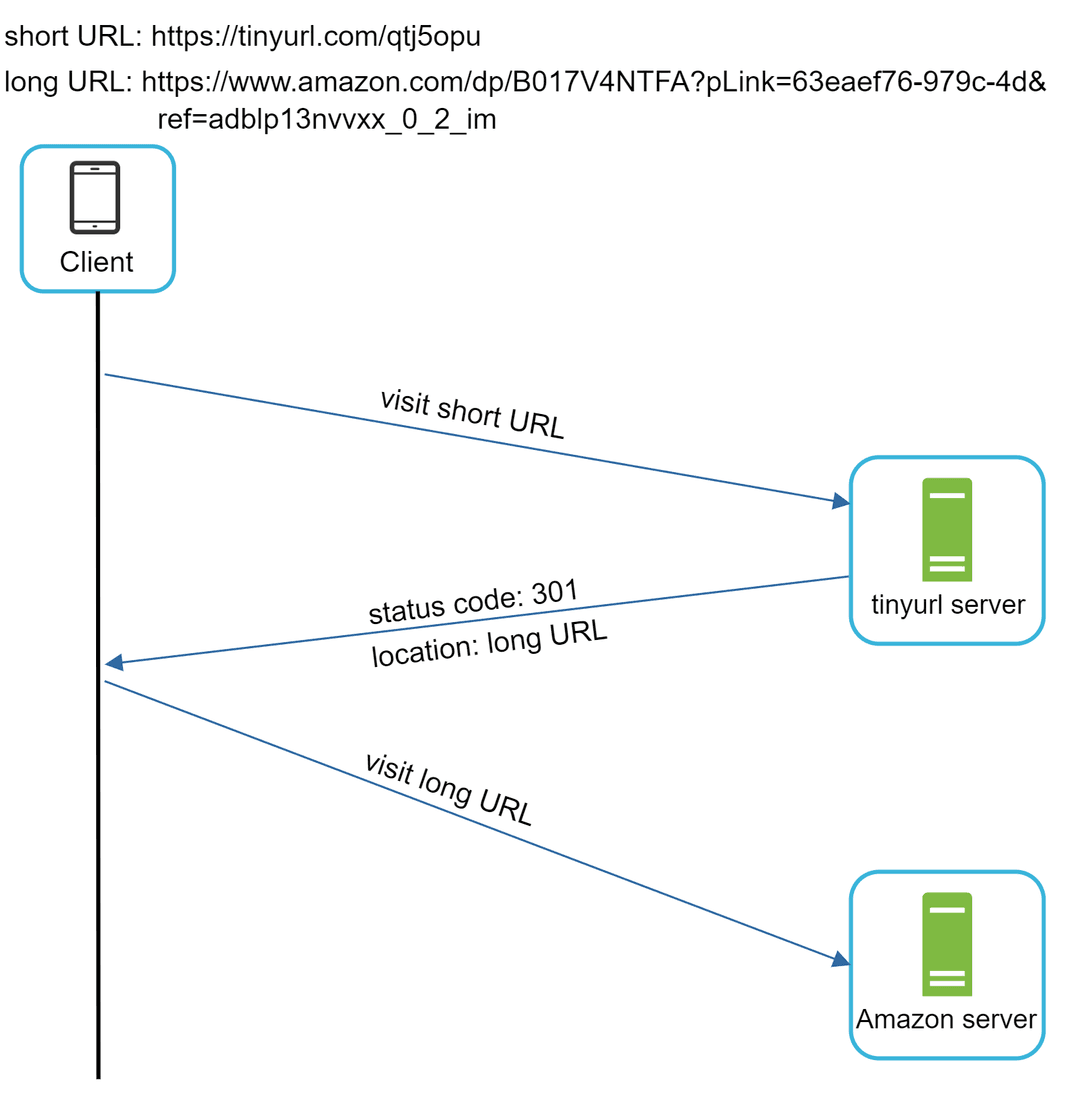
Given shortened url -> redirect to original long url
Non-Functional:
High availability: The url shortener service could run properly even some exception happens.
High scalability: The system should be highly scalable to be able to handle high volume of data
High performant: The system should perform high throughput and low latency
Capacity estimation
1. Traffic volume
- 100 million request per day
- Each shortened URL accessed 10 times
Total requests : 100 million * 10 = 1 billion requests per day
2. How long is the shortened url?
As short as possible
3. What characters are allowed in the shortened url?
A-Z a-z 0-9
4.Write operation per second: 1 billion / 24 /3600 =~ 11600
5. Read operation:
- Assuming radio of read operation to write operation is 10 : 1, so the read operation per second is 116000
- Assume average url lengh is 100 bytes
- Assume url shortener service will run for 10 years, so 1 billion * 365 * 10 = 3.65 trillion
Total storage for 10 years is 100 bytes * 3.65 trillion is 365 PB
API design
- Shorten long url
Post:
/api/v1/data/shorten
request payload:
{longUrl: long url string}
return: shorten url
- Get shorten url
Get:
/api/v1/shortUrl
return: long url
Database design
Apprently, this is a read heavy system, so the relational database is the better option. However, due to this high volume of request per second, we can scale the database horizontally by replicating our database using leader-follower mechanism. For example, we can have one leader replica primarily deal with write operations, and all read operations should be sent to follower replica to get better performance as we have multiple followers.
Design:
Id: 123
shortUrl: tinyUrl
longUrl: xxxx/xxxx/xxxx
High-level design
Request flows
Short url generation flow:
- The client would make the request of the short url generation and check the nearest CDN cache center whether it have the url, and return it directly if url present
- If don't have it in CDN, the request will be sending to the load balancer and distributed to the one of the application server depends on the routing strategies.
- Server will handle and process the request and check whether Redis (cache-aside) have the value, return it if url present
- Otherwise the requests will be sending to the Database and check whether we can get the url from there, and return it if url present in the Database
- If also absent in the database, the server will generate the shorten url and return to the client
- Meanwhile an asynchronized thread will take the url and persist into the database, and also update the cache.
Short url redirect flow:
- The client would make the request to the nearest CDN cache center and redirect to the long url if present
- If not, request will be sending through load balancer to the corresponding application
- Application will take and process the request and check whether the url present in Redis, and redirect to the long url if present
- If not, make the request to the database and redirect to the long url if present
- If also not in the database, return failed response
We can use bloom filter to check whether url is not exist in the database to further reduce the pressure of the database
Detailed component design
Dig deeper into 2-3 components and explain in detail how they work. For example, how well does each component scale? Any relevant algorithm or data structure you like to use for a component? Also you could draw a diagram using the diagramming tool to enhance your design...
Service design:
- How to make the shorten url unique?
Hash + collision resolution
Cache design:
- How would you design the data structure to be stored in the cache?
we can use hash structure of Redis to store it, key is shorten url, value is long url
Trade offs/Tech choices
In approach of Hash and collision that we were selected to make the shorten url unique, we will send the long url + pre defined string request back to the application and repeat the whole process, it will leads to the high volume of request and may overwhelming our application if request traffic is very high
Other approachs dont have to repeat the whole process, but there are some other complexities also, so there are some trade offs and we should utilize them based on our needs.
Failure scenarios/bottlenecks
- For server, If volume is very high, it might overwhelm our application. We can horizentally scale the application and mitigate the pressure of single application
- For CDN, If volume is very high, we might need to buy more CDN instances to handle that
- For Cache, if volume is very high, we can use Redis Cluster to make the whole Cache center highly available (three masters three slaves)
- If everything we've tried still make the database not able to handle such the high volume, we can use leader-less replication to replicate the instance of database, and make the read process to be hitted to the master nodes and slave nodes as well, and write operation only go through the master node to avoid distributed transactions which is very expensive and would introduced much more complexities.
Future improvements
What are some future improvements you would make? How would you mitigate the failure scenario(s) you described above?