Post
QUIC and the End of TCP Sockets: How User-Space Transport Rewrites Flow Control
Why QUIC’s user-space transport lets us ‘kill’ the old app-level event loop: a tour from Tahoe/Reno to Cubic/BBR, then into QUIC’s pacing, loss recovery, and stream-level multiplexing that trim tail latency and jitter at scale.
.png)
By Codemia • October 9, 2025
10 min read
Introduction: For decades, the Internet’s performance has ridden on the back of TCP congestion control algorithms embedded in operating system kernels. From the early days of TCP Tahoe and Reno to modern implementations like Cubic and BBR, each iteration sought to better tame congestion and improve throughput. Yet these kernel-based approaches come with pacing limitations and slow innovation cycles. Enter QUIC – a user-space, UDP-based transport protocol that fundamentally rethinks flow control. QUIC breaks free from the traditional TCP socket paradigm by handling reliability and congestion control in user space, enabling rapid evolution of algorithms, new pacing strategies, and tighter integration with application needs. In this post, we’ll trace the evolution of TCP congestion control (Tahoe, Reno, NewReno, Cubic, BBR) and examine their pacing models and limitations. We’ll then explore how QUIC’s user-space design unlocks new possibilities: from advanced packet pacing and loss recovery to mitigating head-of-line blocking and customizing congestion control per application. Technical comparisons – including flow control differences, RTT variance in QUIC vs kernel TCP, and benchmark data – will illustrate these concepts. Finally, we’ll conclude with actionable takeaways for backend engineers, CDN architects, and protocol enthusiasts on when and why QUIC’s pacing innovations matter.
Evolution of TCP Congestion Control: From Tahoe to BBR
TCP’s congestion control has come a long way from its 1980s origins. TCP Tahoe (1988) introduced the foundational algorithms of slow start (exponential ramp-up of send rate) and additive-increase multiplicative-decrease (AIMD) for congestion avoidance. Tahoe would exponentially increase the congestion window until packet loss occurred, then drastically cut the window and restart slow start. This approach was effective in preventing congestion collapse, but it led to abrupt throughput drops on loss. TCP Reno refined this by adding fast retransmit and fast recovery – instead of dropping all the way down on a loss, Reno cut the congestion window in half and entered a recovery phase, avoiding a full slow start restart. Reno’s AIMD strategy produced a characteristic “sawtooth” throughput pattern: a linear rise of send rate by roughly one segment per RTT, followed by a halving on loss (see blue curve in the figure below). Reno is often described as an ACK-paced algorithm – each incoming ACK triggers the sending of new data, effectively clocking the flow of packets. However, Reno did not explicitly pace packets with timers; it relied on ACK clocking and the network itself to absorb bursts. In steady state, Reno tended to send a burst of packets each RTT (as ACKs arrived) and would overshoot a bottleneck’s capacity until a drop signaled it to cut back.
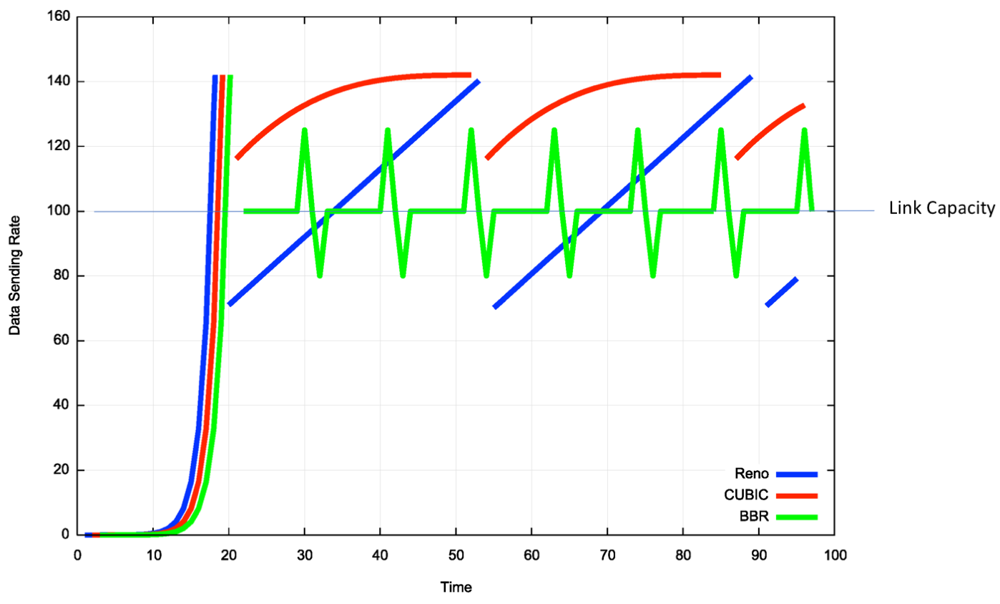
Figure 1: Idealized congestion window evolution for Reno (blue), Cubic (red), and BBR (green) over time on a fixed network path. Reno’s AIMD produces a sawtooth pattern of linear increase and abrupt halving on loss. Cubic grows faster and probes beyond the previous congestion point using a cubic function, causing longer plateaus near capacity (but potentially more queuing delay). BBR maintains a near-flat window around the bottleneck rate using pacing, with small periodic probes (green spikes). Link capacity in this example is around 100 Mbps (horizontal dashed line).
NewReno (mid-1990s) further improved loss recovery by handling multiple lost packets in a window more gracefully (partial ACKs in fast recovery). But fundamentally, Reno/NewReno remained AIMD algorithms that increase by one segment per RTT and cut window on loss – a scheme that can be painfully slow on high-bandwidth*delay product paths. For instance, under Reno, reaching 10 Gbps on a 30ms link could take an impractically long time because the linear increase per RTT becomes a bottleneck.
To better scale to fast, long-haul networks, new algorithms emerged. TCP Cubic (2006) became the default in Linux due to its superior performance on high-speed links. Cubic replaced Reno’s linear window growth with a cubic function of time since the last loss. After a loss event, Cubic remembers the congestion window at the loss point (call it W_max). In the congestion avoidance phase, it then grows the window following , a cubic curve where and are constants that determine the shape. The curve is set to have an inflection point at the previous W_max, meaning Cubic grows quickly at first to recover throughput, then more slowly as it approaches the prior rate, and finally overshoots slightly above W_max to probe for additional bandwidth. This results in a more aggressive initial growth than Reno (to utilize available capacity faster) and a more gentle probing near the maximum (to stabilize and avoid large losses). Importantly, Cubic’s growth is time-based rather than ACK-count-based, making it less sensitive to RTT – it tries to give flows with different RTTs a fairer chance by not tying increase strictly to ACK frequency. In practice, Cubic allows flows to “hug” the capacity closely. However, Cubic’s strategy tends to keep network queues near full for longer, introducing higher standing queue delays (bufferbloat) when capacity is probed. In fact, Cubic will operate a flow just below the onset of packet loss for as long as possible, meaning buffers stay heavily occupied, increasing latency. Cubic improved throughput on big pipes, but at the cost of potential queuing delay – it still relies on packet loss as the primary signal of congestion, filling queues until a drop occurs.
The quest for low latency and high throughput led to BBR (Bottleneck Bandwidth and RTT), developed at Google and made public around 2016-2017. BBR is a departure from loss-based control; it’s a model-based, delay-controlled algorithm. BBR periodically estimates two key path characteristics: the bottleneck bandwidth (the maximum delivery rate recently observed) and the RTT of the path (minimum observed RTT, as a proxy for propagation delay). BBR then drives the connection to operate at the just-full bandwidth while keeping the pipeline delay low – essentially, it tries to send at a rate that fills the pipe but not the queue. To achieve this, packets are paced evenly at the estimated bottleneck rate. Instead of sending a burst of data each RTT (as Reno/Cubic do), BBR spreads out packet transmissions such that it doesn’t rely on the network to smooth out bursts. The contrast is stark: Reno/Cubic tends to send a flurry of packets after each ACK clock tick and let network buffers handle the excess, whereas BBR precisely spaces packets to avoid building queues. BBR continuously adapts by cycling through phases – it will occasionally probe bandwidth by sending 25% faster for a short interval to see if throughput increases (indicating more bandwidth is available). If that probe causes extra delay (RTT rises) with no throughput gain, BBR knows it has filled the buffer and backs off. By monitoring RTT, BBR aims to hover at the onset of queuing, rather than the onset of loss. The result is dramatically lower queue delay for the same throughput: Google reported that BBR flows can achieve the same throughput as Cubic flows with only 1/2 to 1/5 the RTT (queueing latency). In buffer-bloated networks, the RTT reductions are even more pronounced. BBR’s aggressive approach can create challenges (it may grab more than its fair share vs. loss-based flows, and flows with longer RTTs can dominate shorter RTT BBR flows under certain conditions). Nonetheless, BBR demonstrated the power of pacing and delay sensing – it proved that throughput can be maximized and latency minimized by smartly controlling packet timing, not just reacting to loss. Modern Linux TCP implementations now even support pacing for Cubic (using the FQ/Codel queue scheduler) to mitigate burstiness, a nod to BBR’s influence.
Summary of pacing models and limitations: TCP Tahoe/Reno relied on self-clocking (ACK pacing) and AIMD – simple and robust, but slow to grow on fast links and prone to bursting a full window per RTT. NewReno improved loss recovery but didn’t change the pacing model. Cubic’s time-based growth improved link utilization for high BDP paths, but it can saturate buffers and introduce jitter (it’s still essentially “queue-filling” until loss). BBR fundamentally changed the game with pacing and by using RTT as a signal to avoid bufferbloat, achieving higher performance in many scenarios but needing careful tuning for fairness. This evolution set the stage for QUIC: a chance to implement cutting-edge congestion control outside the kernel, where new ideas like BBR could be deployed rapidly and tuned per application.
QUIC in User Space – A New Era for Transport Innovation
One of QUIC’s most radical departures from TCP is where it lives: QUIC is implemented in user space, not the operating system kernel. In practice, QUIC runs on UDP (which is just a thin kernel datapath) and implements transport-layer logic (reliability, congestion control, encryption) in libraries within applications. This architectural choice has profound implications:
- Rapid iteration and deployment: Changes to TCP congestion control or recovery in the kernel require OS updates, kernel module changes, and careful rollout. By contrast, QUIC’s user-space implementation facilitates rapid development and deployment of updates and new features. Developers can ship a new QUIC version with improved congestion control as a normal application/library update – no kernel patches or system reboot required. This agility means protocol innovations can be tested and adopted much faster. As an example, Google deployed and iterated on QUIC (with custom congestion control) within Chrome and its servers well before standardization, something impossible with kernel-only TCP.
- Safety and flexibility: Running in user space offers more flexibility for resource management and experimentation. A bug in a QUIC implementation might affect one server process, not bring down the whole OS (as a kernel bug might). User-space code can be instrumented, debugged, and customized more easily. Applications can also dynamically adjust memory and threading for QUIC without being constrained by kernel defaults.
- Pluggable congestion control algorithms: Perhaps the biggest advantage is the ease of integrating new or custom congestion control. QUIC’s design intentionally separates the wire protocol from the congestion control algorithm – an implementation can choose Cubic, BBR, or any new scheme as needed. For instance, a video streaming service could use BBR in QUIC for smoother throughput, while a bulk transfer tool might experiment with a high-speed AIMD variant – all without waiting for OS support. As a result, QUIC gives** control back to application developers to tailor congestion control to their use case**. This user-space flexibility is already being leveraged: companies and researchers have implemented experimental algorithms (even machine-learning based congestion controllers) on QUIC as prototypes, something that would be cumbersome in a kernel TCP world.
- Enhanced recovery and pacing mechanisms: QUIC’s designers took the opportunity to build in advanced loss recovery and pacing by default – often features that lagged or were optional in TCP. For example, QUIC acknowledgements use ACK ranges to precisely report which packets were received, akin to TCP SACK but part of the core protocol, eliminating ACK ambiguity about whether a packet was lost or just out-of-order. QUIC senders employ packet pacing natively to reduce burstiness and packet loss – pacing is explicitly recommended in the RFC and most implementations include a pacing mechanism. QUIC’s loss detection is time-based and akin to the latest TCP innovations (RACK/TLP): if a packet is deemed lost (e.g. because later packets were acknowledged and a threshold time passed), QUIC retransmits quickly without waiting for multiple duplicate ACKs. Features like Tail Loss Probes (TLP) – sending a spur retransmission when a trailing segment might have been lost – and Proportional Rate Reduction (PRR) – carefully reducing sending rate after loss – are integrated into QUIC’s standard loss recovery. In essence, QUIC got to start with a “best of” selection of modern congestion control practices, whereas TCP implementations in the wild often vary in which enhancements are enabled. The result is often superior performance under edge conditions. For example, one study noted “QUIC outperforms TCP under loss (due to better loss recovery and lack of HOL blocking), and in high-delay networks”.
- User-space timing granularity and challenges: Because QUIC runs in user space, it must use user-space timers and system calls to send packets. Early on, there were concerns about whether QUIC could pace as precisely as kernel TCP. Challenges include coarse timer granularity, scheduling delays, and overhead of frequent send system calls. In practice, modern QUIC stacks have mitigated these issues via techniques like UDP segmentation offload (GSO), batching multiple packets in one syscall, and leveraging high-resolution user-space timers. Research in 2025 showed that “pacing with only user-space timers can work well”, especially when combined with kernel assist (for example, using Linux’s FQ packet scheduler for pacing). QUIC libraries like Facebook’s mvfst or Cloudflare’s quiche use strategies to achieve pacing on par with kernel implementations. There is a trade-off: user-space QUIC incurs slightly higher CPU usage, since the application handles encryption and packet processing that the kernel would do for TCP. On resource-constrained devices (e.g. low-end mobile), heavy QUIC usage could eat more CPU than TCP. However, server-grade hardware and modern devices generally cope well, and the payoff is the ability to innovate quickly and tune behavior precisely.
In summary, by moving the transport logic to user space, QUIC has accelerated the evolution of congestion control and recovery mechanisms. Changes that once took years to trickle down into various OS kernels can now be deployed by updating a library. This freedom comes with responsibility: QUIC implementers must carefully handle things like pacing and timer precision to match kernel performance. But the upside is enormous – QUIC opens the door for new pacing strategies, loss recovery improvements, and even application-specific transport optimizations that were extremely hard to deploy under the reign of kernel TCP.
Flow Control and RTT Variance: QUIC vs Kernel TCP in Practice
Beyond congestion control, QUIC and TCP differ in how they implement flow control and handle data ordering – factors that impact throughput and latency (especially latency variance). Let’s compare how a QUIC connection in user space manages data flow versus a traditional TCP socket in the kernel:
- Receiver flow control (preventing sender overflow): TCP uses a single receive window (advertised in ACKs) to limit how much data in total can be in flight. This is a coarse mechanism – it ensures the sender doesn’t overwhelm the receiver’s buffers, but it applies to the entire TCP stream. QUIC, in contrast, maintains flow control at both the connection level and per stream. The receiver advertises a connection-wide limit (max bytes overall) and also a max stream data for each stream. This means a QUIC sender might be allowed, say, 1 MB of total data in flight, but no more than 256 KB in stream 1, 256 KB in stream 2, etc., as per receiver credit. If one stream’s window is exhausted (the application reading from that stream is slow), QUIC will stop sending on that stream only, but can continue sending other streams that still have credit. By comparison, in TCP if the receiving application falls behind reading from the socket, the single receive window closes and blocks the entire connection. QUIC’s granular flow control thus prevents one sluggish stream from back-pressuring others – an important benefit for multiplexed protocols like HTTP/3. In essence, QUIC knows the data belongs to independent streams and can apportion buffering accordingly. This yields more efficient utilization of bandwidth when multiple objects are in flight.
- Multiplexing and head-of-line blocking: Traditional TCP has no concept of multiple streams – it delivers bytes in one sequence. If byte 100 is lost, bytes >100 cannot be delivered to the application even if they arrived, because TCP enforces in-order delivery for the single byte stream. This is known as head-of-line (HOL) blocking. QUIC’s multiplexing (discussed in detail in the next section) allows out-of-order delivery across streams – QUIC ensures in-order delivery within each stream, but different streams are independent. Practically, this means loss on one stream’s data doesn’t stall bytes from another stream. As long as data for stream B has arrived, QUIC can deliver it to the app even if stream A’s packet is lost and waiting for retransmit. The effect on flow control and latency is significant: applications experience less jitter and delay when using multiple streams over QUIC compared to the same streams multiplexed at the TCP layer (as in HTTP/2). With TCP multiplexing (HTTP/2), a single lost packet creates a delay spike for all streams (they all wait), increasing tail latency. QUIC avoids that cross-stream head-of-line blocking, so latency for unaffected streams remains low. This can lead to more consistent response times (lower RTT variance in delivery) in scenarios like web page loading, where dozens of resources are fetched in parallel. Benchmarks have found that under packet loss, QUIC’s ability to carry on with other streams yields faster overall completion times compared to HTTP/2 over TCP. For example, measurements by Google showed that QUIC improved the tail of page load times – the slowest 1% of connections were one second faster with QUIC than TCP, thanks in part to eliminating head-of-line blocking and improving loss recovery.
- RTT measurement and variance: QUIC implementations have full control over measuring packet timings and RTTs in user space. QUIC explicitly acknowledges packets with timestamps or packet numbers, so senders can compute exact RTT samples for each ACK. TCP in the kernel also measures RTT, of course, but QUIC’s integrated design (with ACK frames and encryption) allows it to gather more precise timing info (e.g., the sender knows exactly which packet an ACK is acknowledging without ambiguity). This precision improves congestion control’s reaction to delay. In terms of RTT variance (jitter), the differences come from congestion behavior: A classic TCP flow (say, TCP Cubic without pacing) might introduce high RTT variance by filling buffers – as the window ramps up, queueing delay increases, then after a loss it drops and delay goes down, leading to an oscillating RTT. QUIC flows, especially those using pacing or BBR, tend to cause less RTT oscillation. For instance, BBR on QUIC tries to keep RTT near the baseline (min RTT) by not overshooting the bandwidth, resulting in more stable latency. If we compare a non-paced Cubic TCP vs a paced QUIC flow on the same path, the QUIC (paced) flow will send packets more evenly, likely yielding a smoother RTT trend (lower jitter) because it avoids big bursts that cause queue buildup. On the flip side, if a QUIC implementation does not pace well (e.g., using coarse timers), it could actually inject irregular gaps or bursts and introduce its own jitter. This was a concern in early QUIC versions, but modern QUIC stacks have largely solved it. In tests on real networks, QUIC and TCP show similar or improved jitter, with one report noting “QUIC still outperformed TCP in almost every measure, with the exception of jitter” being slightly higher in one scenario. It’s worth noting that was an older comparison; as QUIC stacks matured with better pacing, jitter differences have narrowed.
- Performance in loss and high-delay scenarios: QUIC’s flow control and recovery advantages appear most under adverse conditions (lossy or long-RTT paths). A concrete example comes from a 2015 experiment by Connectify: transferring a 10 MB file at 5 Mbps with 160 ms RTT while varying packet loss. With 1% packet loss, standard TCP saw an 80% throughput drop (goodput ~0.7 Mbps), whereas QUIC achieved slightly better (~1.1 Mbps). At 5% loss, QUIC delivered ~0.43 Mbps vs TCP’s ~0.28 Mbps – both suffered greatly, but QUIC was ~55% faster. This improvement was attributed to QUIC’s quicker recovery (and possibly its then-experimental FEC, though FEC was disabled in that test). In high-latency conditions (no loss, RTT from 80 ms up to 800 ms), the same tests showed QUIC initially lagging TCP in throughput at very large RTTs. The Linux TCP stack (with window scaling and perhaps tail loss probes) handled huge BDP better at the time, whereas QUIC’s implementation wasn’t fully optimized for such extremes yet. Over time, these gaps have closed as QUIC integrated better congestion control (e.g., Cubic and BBR). In general, QUIC’s ability to preserve throughput in face of random loss (through fast recovery and not halting all streams) means it tends to shine on flaky networks. Academic studies echoed that “QUIC yields higher throughput than TCP at high loss rates” due to its loss recovery and no-HOL-blocking design.
In short, QUIC’s flow control mechanism is more fine-grained and stream-aware, which helps keep throughput high and latency low when multiple streams share a connection. Meanwhile, its in-built pacing and modern congestion algorithms can reduce RTT variance by preventing queue overfill. Traditional TCP, especially without recent extensions, can suffer from head-of-line blocking and burst-induced jitter, affecting latency and stability. QUIC’s user-space flexibility has allowed it to incorporate the latest ideas to counter these issues, and empirical data shows QUIC often providing smoother and faster delivery, particularly in challenging network conditions.
Mitigating Head-of-Line Blocking and Accelerating Recovery in QUIC
One of QUIC’s headline features is solving the long-vexing problem of head-of-line (HOL) blocking at the transport layer. This improvement, while conceptually simple, required a clean-slate approach – something QUIC delivers by fundamentally redesigning how streams are handled relative to TCP.
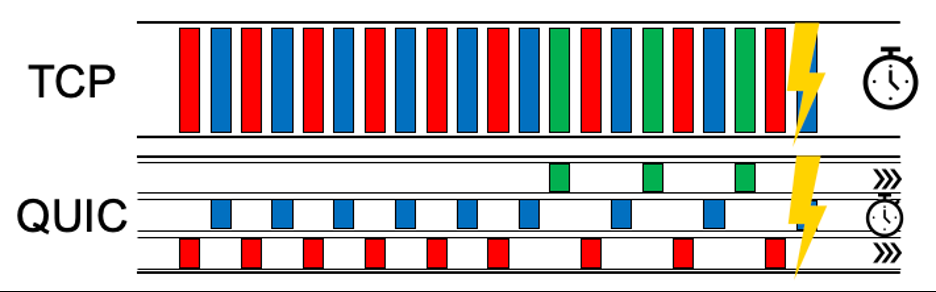
Figure 2: Visualizing head-of-line blocking in TCP vs QUIC. Top: HTTP/2 over TCP carries multiple streams (red, blue, green bars) but TCP treats it as one sequence of bytes. A lost packet (yellow lightning bolt) carrying some blue data stalls all subsequent data – nothing can be delivered until the lost packet is retransmitted (stopwatch indicates the wait). Bottom: HTTP/3 over QUIC sends streams in independent frames over UDP. Here a packet loss affects the blue stream only; QUIC still delivers the red and green stream data that arrived out-of-order, without waiting for blue’s retransmission (notice the red and green bars continue despite the gap in blue). This stream-level independence eliminates cross-stream HOL blocking, allowing other resources to load without delay.
Why TCP has HOL blocking: TCP provides a reliable, in-order byte stream. It has no awareness of multiple higher-level streams (like parallel HTTP requests) riding inside that byte stream. Thus, if byte #N in the TCP stream is lost, TCP will withhold all subsequent bytes from the application until #N is successfully received. In HTTP/1.1 this just delays that single response, but in HTTP/2 (which multiplexes many responses on one TCP), a lost packet means all responses stall momentarily. The downstream application (browser) can’t get data for any stream beyond the gap. As the saying goes, one broken packet can slow everything.
How QUIC avoids HOL blocking: QUIC was designed to be stream-aware at the transport layer. Instead of a single byte sequence, QUIC multiplexes data as frames tagged with stream IDs. Each stream has its own offset and order. The QUIC receiver can reassemble each stream independently. Crucially, if a QUIC packet is lost, the impact is localized to the streams that had data in that packet. Any other streams delivered in other packets can continue unhindered. For example, if QUIC packet 42 (carrying data for Stream A) is lost but packets 43+ (with data for Streams B and C) arrive, Streams B and C can still be processed immediately. The QUIC stack will report new bytes to the application for B and C, while Stream A’s data is pending. There’s no “global” ordering across streams that forces B and C to wait for A. QUIC guarantees order within each stream, but not across different streams – this is the key relaxation that breaks the HOL logjam. The result: in a web page load over HTTP/3, if one large image stream experiences a packet loss, it doesn’t freeze the delivery of HTML or CSS or other images; those can continue, perhaps allowing the page to render critical content faster. QUIC relieves HOL blocking during loss as it knows exactly which stream is affected and can let unaffected streams progress.
The impact on performance can be significant in loss-prone networks or for applications with many parallel streams. Our own study (Figure 2 above) illustrates that with QUIC, only the blue stream saw a stall whereas TCP would stall everything. In high random loss scenarios, QUIC’s advantage grows: one research paper found that in scenarios of 5–10% packet loss, QUIC’s ability to utilize other streams improved page load times noticeably when using parallel resource prioritization, whereas in TCP the losses serialized through a single HOL point. In low loss or single-stream cases, QUIC’s HOL blocking benefit is moot (if there’s only one stream, QUIC behaves similar to TCP in terms of ordering). But today’s web and many protocols are highly concurrent, making this a big win.
It’s important to acknowledge that QUIC’s solution required adjustments in higher layers. HTTP/2’s design assumed strict ordering (e.g., for header compression and priority signals). With QUIC delivering streams out-of-order, HTTP/3 had to introduce new mechanisms (like QPACK for headers) that tolerate out-of-order delivery. These were non-trivial changes, but they underscore how valuable eliminating HOL blocking was – so much that the industry was willing to overhaul parts of the HTTP layering to get there.
Beyond HOL blocking, QUIC also accelerates loss recovery and connection recovery in ways TCP cannot:
- Faster loss detection: QUIC senders don’t rely on duplicate ACK counts alone (the classic “3 dupe ACKs” of TCP) to infer loss. They use a notion of packet loss detection by timeout and gap similar to TCP’s RACK/TLP. For instance, if one or more packets are not acknowledged while later packets are, QUIC can declare them lost after a short delay (often on the order of 1 RTT or less) and retransmit. Because QUIC ACKs explicitly list missing packet numbers, there is no ambiguity – the sender knows exactly which packet didn’t arrive. This means QUIC often retransmits lost data sooner than TCP Reno/NewReno would, especially in scenarios where only one packet was lost (TCP might wait for 3 dup ACKs which may not arrive if only one packet in a window was lost, causing a timeout). QUIC also employs Tail Loss Probe logic: if the last packets of a flight might be lost (no ACKs coming), it will proactively retransmit one to trigger an ACK, avoiding a full-blown timeout. All of this leads to snappier recovery from loss – fewer and shorter stalls.
- No HOL blocking = faster recovery for other streams: Not only does QUIC retransmit faster, but as explained, other streams don’t wait. For TCP, even if a lost packet is retransmitted quickly, the delivered-out-of-order data was sitting idle in the receive buffer not being used. QUIC puts any in-order stream data to use immediately. Thus, the application-layer impact of loss is lower. In a video call using QUIC, a lost packet in the video stream doesn’t halt an audio stream; the audio can keep playing, potentially concealing the video glitch. Or in a file download manager, one parallel transfer’s loss won’t slow down others.
- Connection migration and resiliency: QUIC can recover not only from packet loss but from path changes. If a device’s network interface changes (e.g., Wi-Fi to 4G), QUIC can migrate the connection to the new IP without resetting the connection. This isn’t directly “flow control” in the sense of congestion window, but it’s a recovery mechanism for connectivity loss that TCP cannot do (a change of IP breaks a TCP socket). For mobile applications, this means QUIC connections are more robust – fewer disconnects and restarts. From a flow perspective, after migration, QUIC might experience a change in RTT or bandwidth, but it can ramp up quickly using its congestion controller without a full restart handshake. This contributes to better continuity (no need to re-establish slow start from scratch after a network switch, for example).
- Integrated congestion + retransmission logic: In QUIC, loss recovery and congestion control are developed in tandem as part of one spec and codebase. In TCP, congestion control evolved as an add-on (with many OS-specific differences). QUIC congestion controllers (whether Cubic, BBR, etc.) can directly factor in QUIC-specific signals. For example, a QUIC implementation knows if a packet was declared lost due to timeout vs due to an ACK of a higher packet number – it could choose to treat these events differently (maybe a timeout indicates potential severe network issue vs an out-of-order ACK indicates mild reordering). Having this logic in user space means QUIC can innovate with hybrid loss/congestion responses. It even allows for things like application-informed loss handling: an app could conceivably tell QUIC “don’t bother retransmitting that frame if lost” (if it’s no longer needed). A kernel TCP would never allow such nuance.
In summary, QUIC’s design eradicates transport-layer head-of-line blocking, which removes a major performance bottleneck for multiplexed streams. It also tightly intertwines loss recovery with congestion control in an agile user-space implementation, yielding faster reaction to losses and more resilience to network disruptions. The end result for users is often a snappier experience: fewer pauses when packets are lost and quicker recovery to full speed. For protocol enthusiasts, it’s a glimpse of what was hard to do in TCP’s kernel world (where legacy constraints abound) but becomes possible when you reimagine the transport layer afresh.
Congestion Control Meets Application: Tailoring QUIC to Application Needs
By moving transport into user land, QUIC creates opportunities to align the transport behavior with application requirements in ways that weren’t feasible with kernel TCP. This tight integration manifests in several ways:
- Priority and scheduling of streams: Applications using QUIC (e.g., HTTP/3 in a browser, or a multiplayer game) can assign priority levels to streams. Because QUIC handles multiplexing in user space, it can respect these priorities when scheduling packets. For instance, a web browser knows that the HTML and CSS streams are higher priority than an image stream. It can signal this to the QUIC layer, which will then ensure that, say, bytes for the HTML stream are put into QUIC packets before filling any leftover space with lower-priority image bytes. In HTTP/2 over TCP, there was also a priority concept, but the TCP layer had no knowledge of it – if TCP’s congestion window allowed 10 KB, the HTTP/2 layer could choose which stream data to send first, but once that data was in the TCP socket buffer, the kernel would just blast it out in order. If a high-priority item became available slightly later, it was too late – it had to queue behind what was already in flight. QUIC, being in charge of packet formation, can make real-time decisions about which stream’s data to send next. It’s like having an application-specific scheduler inside the transport. This leads to better alignment with app needs: critical data can genuinely go first. In practice, current HTTP/3 priorities are simpler than HTTP/2’s, but QUIC opens the door to more sophisticated scheduling policies in the future because that logic can live in user space with full context. Indeed, as researchers note, “moving streams to the transport layer with QUIC opens a new parameter space for optimizations” in how data is scheduled and prioritized.
- Custom congestion control per application: Different applications have different notions of “optimal” network behavior. A video streaming service cares about consistent throughput and low jitter; a bulk file transfer might care only about raw throughput; an interactive game cares about ultra-low latency even at the cost of bandwidth efficiency. With kernel TCP, everyone was stuck with the system-wide congestion control (usually Cubic). QUIC lets each application (or each connection) choose or even design a congestion control algorithm suited to its needs. For example, an interactive application could use a QUIC CC that sacrifices some bandwidth to cut down latency spikes. An IoT telemetry application sending small, infrequent bursts might use a very mild congestion controller that avoids overshooting at all. QUIC’s modular nature means an organization can implement a new CC in their QUIC library and deploy it to clients and servers it controls – no OS update needed. As a concrete example, Google has experimented with deploying BBR congestion control for QUIC traffic serving YouTube videos, since BBR can reduce buffering latency for streaming users. Others have explored CC algorithms that adapt to cellular network variability, implemented entirely in user-space QUIC. The user-space advantage is clear here: “Instead of waiting for OS-level updates, developers can deploy enhancements directly through their application… QUIC gives control back to protocol engineers to tailor CC, e.g. using BBR for throughput or custom pacing for real-time apps.”. This flexibility is unprecedented – we’re no longer tied to one-size-fits-all congestion control.
- Application-informed loss handling: Since the application using QUIC is typically in the same process (or at least can interact with the QUIC library), it can make smarter decisions when network issues occur. For instance, consider a live video application: if a video frame packet is lost and arrives late, it might be useless (the frame missed its play deadline). A QUIC-based video app could use the emerging partial reliability extension of QUIC to say “if frame X is lost and not recovered within 100ms, skip it.” This prevents wasting bandwidth on a pointless retransmission and frees up capacity for the next frame. With TCP, you cannot easily choose to skip data – the transport will always retransmit until delivered in order. QUIC’s design allows an application to implement such logic (with custom stream types or extensions), trading off reliability for timeliness when appropriate. Another example: a messaging app could mark typing notification packets as “don’t retransmit if lost” because missing one isn’t critical, whereas file transfer packets must be reliable. This kind of nuanced control is far easier in QUIC’s framework. Even without using protocol extensions, the mere fact that QUIC delivers data as soon as it’s available means the application can decide how to handle missing pieces sooner.
- Real-time feedback and adaptation: A QUIC stack can expose rich metrics to the application – current estimated bandwidth, RTT samples, congestion window, packet loss events, etc. A kernel TCP might expose some info via APIs like TCP_INFO, but those are limited snapshots and not easily used for on-the-fly adjustments. With QUIC, an application could continually monitor the connection’s quality and adapt its behavior. For example, a media server noticing rising loss and RTT could proactively switch to a lower bitrate or change video codec settings to reduce bandwidth, before the user experiences buffering. Essentially, QUIC makes it easier to close the loop between network conditions and application behavior, because the transport is part of the app. Some Web transport APIs (WebTransport over QUIC) are looking into exposing such metrics to JavaScript apps in the browser, enabling smarter client-side adaptation as well.
- Case study – CDN and edge servers: CDN architects can leverage QUIC to optimize content delivery. Many CDNs terminate TLS and TCP at edge servers; with QUIC, they can fine-tune the congestion control on those links. For instance, a CDN could use a less aggressive CC for congested regions to minimize packet loss (improving user experience), or prioritize certain traffic types (videos vs small images) differently. Because QUIC is encrypted and runs on UDP, it also avoids interference from middleboxes that might have impeded new TCP mechanisms (like some networks that didn’t handle TCP Fast Open or custom options well). QUIC is designed to prevent ossification – network devices mostly treat it as opaque UDP traffic – so CDN operators have more freedom to innovate end-to-end. We’ve already seen many major cloud providers and CDNs (Google, Cloudflare, Facebook) roll out QUIC/HTTP3 and report gains. Google cited a 8% mean reduction in Google Search latency on desktop (3.5% on mobile) and significant video rebuffer reduction (15-18%) when using QUIC. These improvements were attributed to QUIC’s features like lower handshake overhead, but also improved loss recovery and multiplexing – essentially the holistic benefits of tight integration between the protocol and application needs.
- Security and protocol agility: (As a side note, integrating TLS encryption into QUIC also helps application needs – every QUIC connection is secure by default, and apps don’t have to separately manage TLS handshakes. This isn’t directly about flow control, but it simplifies development while improving privacy. It also means things like packet acknowledgements and congestion signals are hidden from observers, which can prevent some interference by middleboxes.) Additionally, if an application needs to update its cryptography or add a new transport feature (say, an improved FEC mechanism for error correction), doing so in QUIC is just a matter of deploying a new version. This agility has led some to call QUIC “TCP/TLS/HTTP2 2.0” – it’s an evolution that bundles and optimizes across layers.
The bottom line is that QUIC’s user-space, stream-multiplexed architecture enables a tight coupling between transport logic and application goals. Developers can fine-tune congestion control, pacing, and recovery to best serve the application, whether that’s minimizing latency outliers, maximizing throughput, prioritizing certain data, or reducing retransmission overhead for non-critical data. This level of control simply wasn’t available with traditional TCP sockets where the kernel’s behavior was fixed and oblivious to app-level context. With QUIC, the transport becomes an extension of the application – an era of “bespoke transport protocols” tailored to specific workloads is emerging. For backend engineers and protocol designers, this is an exciting development: we are no longer stuck with a one-size-fits-all TCP, we can rewrite flow control on our own terms.
Takeaways for Engineers: When and Why QUIC’s Pacing Matters
For backend engineers, CDN architects, and protocol enthusiasts, QUIC isn’t just a shiny new toy – it offers practical benefits that can be critical in real-world systems. Here are some actionable takeaways on when and why QUIC (and its advanced pacing & flow control) matters:
- Use QUIC for multiplexed streams to eliminate head-of-line pain: If your application or service involves multiple parallel requests or streams (typical in web pages, API calls, microservices fetching data, etc.), QUIC will prevent one slow or lost packet from blocking the rest. This leads to faster page load times and better utilization of the network. For example, HTTP/3 (QUIC) has shown ~3-8% improvements in page load metrics and much larger gains for high-percentile (worst-case) latencies compared to HTTP/2. When you care about consistent low latency – say, ensuring that one tiny request isn’t delayed by an unrelated large transfer – QUIC’s stream independence is a game-changer. In short, for any scenario currently using HTTP/2 or any multiplexing over TCP, migrating to QUIC can cut tail latency and improve resilience to packet loss.
- Leverage QUIC’s pacing on high-bandwidth or lossy networks: QUIC’s ability to pace packets (either via BBR or paced versions of Cubic/NewReno) means it can reduce bufferbloat and packet loss on links that are near capacity. If you operate services over networks with high bandwidth*delay products (e.g., satellite links, long-haul WAN, 5G connections), enabling a paced congestion control (like BBR) in QUIC can dramatically improve throughput and latency. For example, Google saw 2x to 20x throughput increases in some internal WANs by using BBR, along with RTT reductions to a fraction of what loss-based TCP incurred. Backend engineers sending large volumes of data (video, large files) should care about this – QUIC with modern CC will fill the pipe more efficiently and with lower latency. Similarly, on networks prone to loss (Wi-Fi, mobile), QUIC’s fast recovery and FEC options can maintain throughput better. Bottom line: If you’re pushing bandwidth limits or dealing with flaky connections, QUIC’s smarter flow control prevents the “cliff effect” where a bit of loss or queueing causes a throughput collapse.
- Take advantage of user-space control to optimize for your use case: As an architect, realize that you can tune QUIC in ways impossible with TCP. You can A/B test Cubic vs BBR vs new algorithms on your traffic easily. You can set initial congestion windows, pacing rates, or adjust how aggressive loss recovery is, all at the application level. For CDN providers, this means you could customize congestion control per region or per content type – e.g., use a very latency-sensitive algorithm for interactive traffic, and a high-throughput algorithm for bulk content. If you have an application that demands ultra-low latency (gaming, VoIP), QUIC lets you experiment with strategies like sending redundant data, or using smaller packets at higher frequency, etc., without kernel hacks. Many of QUIC’s benefits (like 0-RTT connections, or avoiding handshake latency) also directly improve user experience for interactive services. In practice: companies like Uber have reported improvements in tail latency of their API calls after moving to QUIC, and CDNs have found better performance delivering video segments over QUIC due to reduced rebuffering. If performance and controllability are critical, QUIC is an enabler.
- Mind the CPU and optimize the implementation: QUIC’s gains come with a cost: more CPU usage in user space (for encryption, packet handling) and more complexity in the application. Engineers should be aware of this trade-off. In highly optimized environments (like kernel bypass or DPDK-based user-space networking), QUIC can be extremely fast, but if you simply use a naive QUIC library on a busy server, you might see higher CPU than with kernel TCP. Techniques like UDP GSO (batching sends), I/O ring buffers (io_uring on Linux), and proper pacing via kernel schedulers (FQ, etc.) can offload some work and improve efficiency. Additionally, because QUIC encrypts more metadata, some network monitoring tasks (packet inspection, etc.) might require new approaches (like using QUIC logs or stats APIs). So, while deploying QUIC, ensure your ops teams have the tooling to monitor QUIC performance (loss rates, RTTs, etc.) via the QUIC stack’s metrics since traditional TCP tooling may not directly apply. For mobile apps, keep an eye on battery/CPU impact, though in our experience, the latency improvements often outweigh the slight increase in CPU.
- QUIC is evolving – stay updated: The QUIC ecosystem is rapidly innovating. New congestion control ideas (like BBRv2, hybrid loss-delay algorithms, even AI-driven controllers) are being built and tested on QUIC. The protocol itself is extending (e.g., datagram frames for unreliable data, multipath QUIC for using multiple networks at once, etc.). As an enthusiast or practitioner, keeping track of the latest QUIC drafts and implementations can give you an edge. Since QUIC can be deployed on a per-application basis, you don’t have to wait for OS vendors – you can often grab a new library version and get improvements. For example, if a QUIC library adds a new pacing improvement or a fix for a reordering issue, updating it could instantly benefit your application’s users (whereas a TCP fix might only come with the next OS update months later). In essence, the transport layer is now part of your application – treat it like application code. Profile it, tune it, and update it just as you would your database or any other critical component.
Conclusion: QUIC and its user-space transport paradigm herald “the end of TCP sockets” in the sense that we no longer view the transport as an untouchable kernel black box. Flow control is now a part of application design. QUIC’s advanced pacing, congestion control flexibility, and loss recovery give us tools to build faster, more reliable systems tailored to our needs. Whether you’re trying to shave off milliseconds of latency or ensure high throughput over dodgy networks, QUIC provides a pathway to achieve it in ways TCP could not easily handle. As networks continue to evolve (5G, Starlink, etc.), having a user-space transport means we can evolve right along with them. The advice for engineers is clear: embrace QUIC where it makes sense – especially for latency-sensitive, multiplexed, or high-throughput services – and leverage its pacing and flow control innovations to deliver better experiences to users. QUIC’s not a magic bullet, but it’s a powerful upgrade to our transport toolbox, enabling a new era of application-driven network performance improvements.