Object-Oriented Design questions and answers
Classes, interfaces, inheritance and design patterns. Page 5 of 6.
Object-Oriented Design practice on Codemia
Turn requirements into classes, and defend the design, on the problems that come up in OOD rounds.
Answers 241-300
- What does Class? mean in Java?
- What does Protocol ... can only be used as a generic constraint because it has Self or associated type requirements mean?
- What does 'super' do in Python? - difference between super.__init__ and explicit superclass __init__
- What does T angle brackets mean in Java?
- What does T denote in C
- What does T mean in C?
- What does the question mark in Java generics' type parameter mean?
- What does the spring annotation ConditionalOnMissingBean do?
- What exactly is Field Injection and how to avoid it?
- What is a difference between ? super E and ? extends E?
- What is a raw type and why shouldn't we use it?
- What is a singleton in C?
- What is Bulkhead Pattern used by Hystrix?
- What is lazy initialization and why is it useful?
- What is PECS (Producer Extends Consumer Super)?
- What is the best way of implementing a singleton in Python?
- What is the difference between ? and Object in Java generics?
- What is the difference between Builder Design pattern and Factory Design pattern?
- What is the difference between ''E'', ''T'', and ''?'' for Java generics?
- What is the difference between Factory and Strategy patterns?
- What is the difference between @Inject and @Autowired in Spring Framework? Which one to use under what condition?
- What is the difference between List of T and Collectionof T?
- What is the difference between public, private, and protected inheritance?
- What is the Execute Around idiom?
- What is the generic version of a Hashtable?
- What is the main difference between Inheritance and Polymorphism?
- What is the point of the diamond operator (<>) in Java?
- What is the replacement for the deprecated MockBeans in SpringBoot 3.4.0?
- What's the correct alternative to static method inheritance?
- What's the difference between an Algorithm and a Design Pattern
- When and why would you seal a class?
- When do Java generics require ? extends T instead of T and is there any downside of switching?
- When should we use Observer and Observable?
- When to use abstract classes?
- Where do operations on models belong in Application Design Patterns?
- Where does Microsoft.Practices.ServiceLocation come from?
- Where to put Bean in Spring Boot?
- Which .NET Dependency Injection frameworks are worth looking into?
- Why are arrays covariant but generics are invariant?
- Why are properties without a setter not serialized
- Why are Python's 'private' methods not actually private?
- Why C structs cannot be inherited?
- Why CQRS and Event Sourcing design pattern is getting popular recently?
- Why do Python classes inherit object?
- Why does does it really? ListT implement all these interfaces, not just IListT?
- Why doesn't C infer my generic types?
- Why doesn't Java allow generic subclasses of Throwable?
- Why don't associated types for protocols use generic type syntax in Swift?
- Why don't Java Generics support primitive types?
- Why don't structs support inheritance?
- Why exactly isn't MEF a DI/IoC container?
- Why is 0 a type in Microsoft Intermediate Language MSIL?
- Why is IoC / DI not common in Python?
- Why is my Spring @Autowired field null?
- Why is there no multiple inheritance in Java, but implementing multiple interfaces is allowed?
- Why is Thread not an abstract class and start not final?
- Why no ICloneableT?
- Why not inherit from ListT?
- Why seal a class?
- Why shouldn't Java enum literals be able to have generic type parameters?
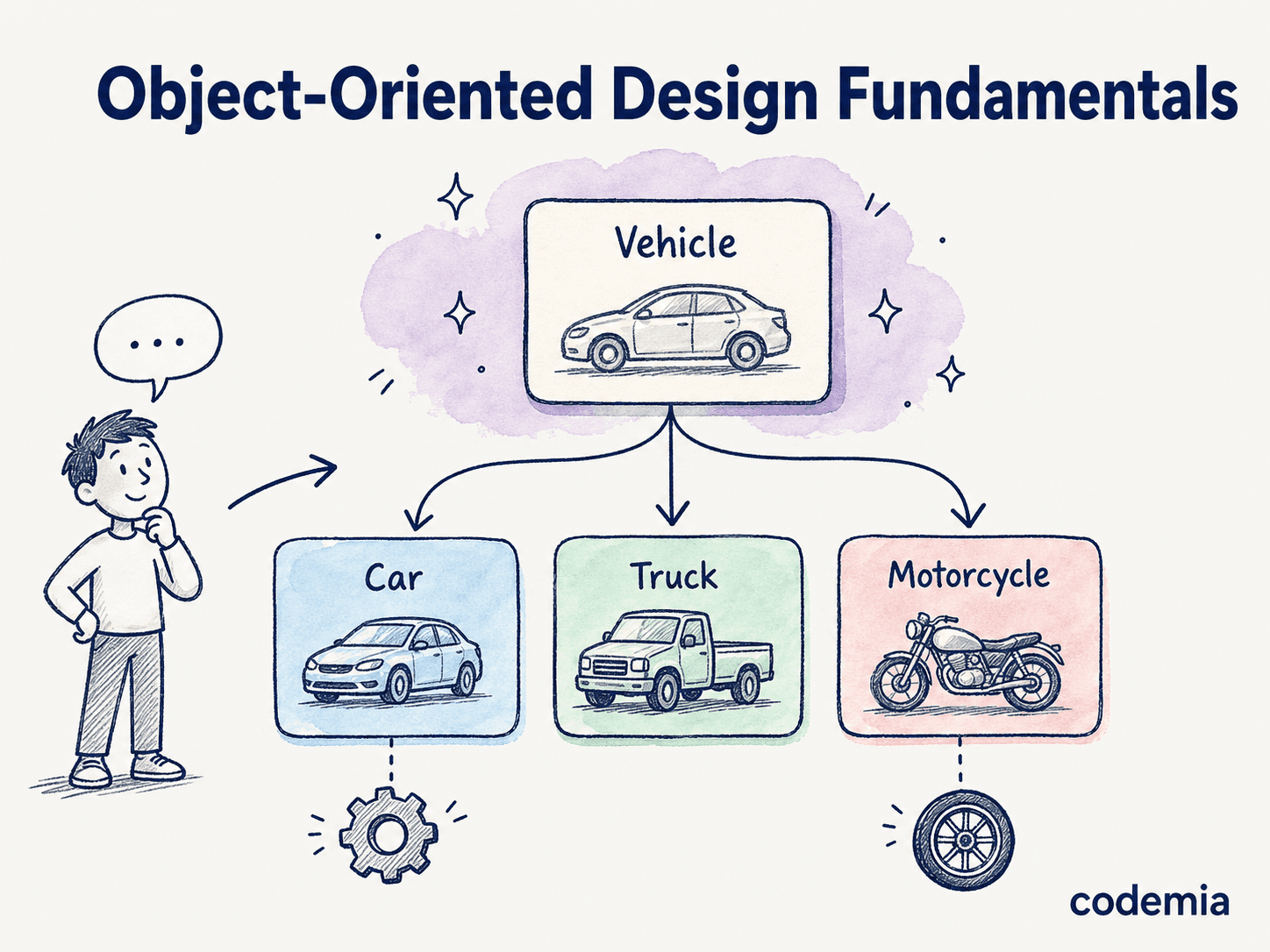
Course
Intermediate
27 lessons
14 hours
OOD Fundamentals
Master object-oriented design from first principles, SOLID, design patterns, and classic interview problems with hands-on coding.
View the course